Showing posts with label Field report. Show all posts

Wednesday, October 20, 2010

Lettre au staff de Molly Melching, Directrice Exécutive de Tostan (rencontre mWoman)


Chère Famille Tostan,

Vous êtes sans doute au courant que j'ai été invitée hier par Hillary Clinton,  la Ministre des Affaires Etrangères (Secrétaire d’Etat) du Gouvernement des Etats Unis, à participer au lancement de mWoman, une initiative destinée à promouvoir l'utilisation des téléphones portables, en particulier en direction des femmes.  La cérémonie a eu lieu dans la salle Benjamin Franklin du Département d'Etat à Washington DC.

J'ai rencontré Hillary dans une salle à part avant la cérémonie.  Elle m'a demandé des nouvelles de tous les membres du staff de Tostan et elle m'a dit qu'elle a entendu de bonnes choses par rapport au travail que nous avons accompli dans plusieurs pays de l'Afrique.  Elle m'a demandé de bien saluer tous les membres de l’équipe, ainsi que les participants qui continuent à œuvrer pour le bien-être de leur communauté.  Nous avons pris des photos que je vous enverrai bientôt. 

Dans son discours pendant la cérémonie, elle a cité le travail important réalisé par Tostan devant des membres du Gouvernement des Etats Unis, des Directeurs de sociétés de téléphones portables (Nokia, Eriksson, etc.) et d'autres invités de marque. 

Son Directeur de Cabinet m'a informé que la Secrétaire d'Etat parle très souvent de Tostan dans ses discours.  Elle répète inlassablement que Tostan est un modèle d'ONG dynamique et à fort impact qui continue à innover et s'occuper continuellement du bien des populations. 

J'ai participé ensuite à un panel de grandes personnalités dont Cherie Blair, la femme de Tony Blair (qui cite souvent Tostan également), pour parler de notre Initiative Jokko - l'utilisation du téléphone portable pour l'alphabétisation et le développement.  Les gens étaient très impressionnés par le travail accompli et les résultats de notre récente évaluation.  Plusieurs sont venus après demander une collaboration - Nokia, GSMA et d'autres.

Je tenais à partager avec vous cette journée importante pour Tostan et par la même occasion vous féliciter pour tout le travail que vous avez accompli. Aujourd’hui, je suis très fière et j'espère que vous l'êtes aussi : vous êtes des modèles observés, écoutés et respectés partout dans le monde.

Wow !


Molly

Thursday, July 8, 2010

Talking RapidSMS in Vélingara

Last week I traveled to Vélingara, a department in Southern Senegal, to talk to community members about their experience with the Jokko module and with the RapidSMS-based Community Forum. Once there, I met up with Malick Niang (Proj. Coordinator for Senegal), Finté Boiro (Assistant Coordinator, Kolda), Alimatou Diao and Almamy Yoro Badji (Supervisors, Kolda), and we headed out into the villages.

For those of you who are new to the Jokko Initiative, a brief recap : In April 2009, Tostan collaborated with UNICEF to launch the RapidSMS-based « Community Forum » in 15 villages in the department of Vélingara where the Jokko module was being taught.


Vélingara department, Senegal. Villages where the Jokko module was taught marked with a pink dot. 

In a nutshell, the Community Forum is a practical, SMS-based application that allows a community member to disseminate information to a virtual network of his or her peers by sending a single text message to Tostan’s server. In the villages where we piloted the Community Forum, participants in the Jokko module not only learned how to use a mobile phone and send text messages, but received training in RapidSMS technology. Our goal : to provide community members with tools to bolster their local development initiatives- especially those that involve mobilizing people around common causes to effect positive social change.  

One year later, it was high time for a field visit to talk RapidSMS with community members. We split our time between two primarily Pulaar villages, Sare Dialo and Barkatou, in which we had identified many "power users": people who frequently send messages to the Community Forum on themes related to development and social mobilization.

With this tool, the Jokko team is able to visualize all text messages sent in the Community Forum.

The feedback we received confirmed many of our initial hopes. Overwhelmingly, community members find the Community Forum to be extremely beneficial to their communities and would like to see the system expanded to other villages and regions of the country. We also found that many of those using RapidSMS were not participants in the Jokko module, and some don’t even live in the villages- news and know-how traveled fast!


Alimatou and I jump into a group shot of the women and children of Barkatou.


So what did RapidSMS users have to say? Those interviewed confirmed much of what we already knew as members of the Community Forum ourselves : community members use RapidSMS to disseminate information and to organize meetings and events on an array of themes including vaccination campaigns, bed net distribution for malaria prevention, village clean-ups and school enrollment for children.

For me, two anecdotes were particularly illustrative of the beneficial potentialities of RapidSMS technology, and of SMS technology in general.

In Sare Dialo, we spoke with two RapidSMS users, Khadiatou M’Ballo and Dieynabou Baldé, who are physically disabled. Both are also extremely active in local development issues and described how they used the Community Forum for these purposes. Of greater interest to me, however, was the story of social empowerment that emerged from their testimonial. Dieynabou learned how to read, write, and send a text message in Tostan's education program. Now she uses the Community Forum to arrange transportation to community events that shy might not otherwise be able to attend.

Khadiatou M’Ballo and Dieynabou Baldé, local activists and RapidSMS users in Sare Dialo.

A second anecdote, related to me by multiple users, is emblematic of the potential of RapidSMS technology to accelerate the diffusion of and to help reinforce positive social change : A man wanted to have his young daughter cut, despite the fact that his village had collectively decided to abandon the harmful traditional practice of female genital cutting. Other villagers sent messages to the Community Forum to warn community members of the man’s intentions. The news spread rapidly, and in the face of overwhelming social pressure, the man renounced his intention to have his daughter cut.  As many community members we spoke with pointed out, mobile technology can be harnessed to accelerate the grassroots movement in Senegal for the nationwide abandonment of FGC and early/forced marriage. 

Back in Dakar, the Jokko team is finalizing a new and improved Jokko module- the fruit of our Capitalization Seminar back in May- and preparing for the early Fall launch of the Jokko community telecenters, in collaboration with Rural Energy Foundation.


Lindsay Powell


Wednesday, June 23, 2010

Documenting the Jokko Experience in Touba

Last week, Guillaume (Project Manager, Tostan International), Malick (Project Coordinator for Senegal) and I traveled to Touba, Senegal, to sit in on classes at four different centers where the Jokko module, which teaches participants how to use mobile technology to improve their lives, is currently being taught. 


The majority of participants in Tostan’s programs are women and girls, but in Touba all of the participants in the Jokko module - as well as all of the Facilitators leading the classes - are female.  Given the conservative environment of Touba – a holy site that is a destination of pilgrimage for Muslims across the globe – this fact is all the more remarkable.


The dynamism of the participants was unmistakable. Despite the potential distractions posed by the presence of three newcomers with video cameras and lots of questions, the participants remained highly engaged with the Facilitators. In fact, the only time that any of the participants seemed to pay us any attention at all was when they snapped our photos with their own camera phones (!).


What made me think I would be the only one snapping pictures?

The sheer motivation and the level of skill that participants demonstrated with mobile phones in each of the classes we visited was excellent. Over the course of two very productive days, we managed to gather a tremendous amount of feedback and to make important observations that will help us as we scale up and implement new activities in the coming months. 


DAY 1

  • Khai-ra 2

At the Khai-ra 2 center, the class was working on Session #6 : The Mango Tree Workshop.  Participants learn how to navigate the main menu of a standard mobile phone with the help of a visual aid in the form of a mango tree.


A participant at the board explains how to access the calculator function by tracing her steps along the branches of a mango tree representing the different manipulations possible.


Participants walk through a larger, more interactive version of the mango tree excerise outdoors.


Once the session had ended, we interviewed two young women who explained that one of their reasons for participating in Tostan’s program was so that they could learn to read and write in their national language, Wolof. After participating in the Jokko module, they can now compose text messages in Wolof without assistance.


  • Touba Bêgg Bamba


At the second center of the day, participants greeted us with a skit demonstrating the cost-efficiency of SMS texting relative to placing a call. An animated discussion with participants brought forth some interesting stories about how the knowledge gained in the classes has affected their everyday lives. One adult participant related how her husband had prevented her from using the household mobile phone, fearing that she would waste the credit, as she did not know how to properly use the phone. Once she demonstrated what she had learned in the Jokko module, her husband began to let her use the phone and now plans on purchasing a second.


Participants who have their own mobile phones - some being relatively sophisticated - bring them to class.

Like at the Khai-ra 2 center, a major theme that emerged from the participant’s personal stories was that of social empowerment. Facilitators and participants explained how friends, relatives and community members now sought their help in using mobile phones and how they frequently shared their newly acquired knowledge with those around them.

Participants also spoke of the sense of autonomy and independence engendered by knowing how to use certain mobile phone functions. For example, several young women explained how before they began the Jokko module, they did not know how to send text messages and were forced to ask someone to send text messages on their behalf. Now, mid-way through the Jokko module, they no longer need assistance to send text messages and appreciate the discretion this allows them.


Boys are eager to get in on the action. The doorways and windows of most classrooms are typically crowded with other community members curious about mobile technology.


DAY 2

  • Touba Palléne


Participants follow along on the Nokia 1202 handsets provided by Tostan in classroom.


At the Touba Palléne center, Session 12: "SMS and Health" was being covered. At this point in the module, participants apply the skills they’ve gained to specific themes (such as health, agriculture, and the environment) relevant to their everyday lives. In this session, participants learn how to send text messages to spread news about vaccinations and awareness-raising campaigns, to make appointments at health clinics, and to ask for advice on matters concerning health and hygiene.

  • Touba Diémoule

Our last stop was the Touba Diémoule center, where we engaged in a lively discussion with the participants about their experience both inside and outside the classroom. A major topic was access to mobile phones: To what extent do our participants have access to mobile phones outside of the classroom? What kind of barriers to access do they face ? . The more surprising answers we received concerned utility: participants  did not fully grasp the usefulness of mobile phones prior to starting the Jokko module. Once they understood that a mobile phone could be used for far more than  making and receiving calls, and how functions such as the alarm and the calculator were relevant to their everyday lives, they were much more motivated to use them.


Participants often share mobile phones in the classroom and help one another to learn. However, participants and Facilitators alike expressed a demand for additional mobile phones to use in the classroom.


We’d like to thank Madame Bousso Gaye Diop –  Supervisor for Tostan’s Touba Coordination – for her careful planning, Serigne Fallou Fall for his time and for hosting our classes at Touba Pallène, our talented Facilitators – especially N'deye Fatou Fall, N'déye Binta N'diaye, Aminata Basse, Fatou M'backé N'diaye -  and all of our highly engaged and motivated participants in Touba.


Contributed by Lindsay Powell, Edited by Sydney Skov
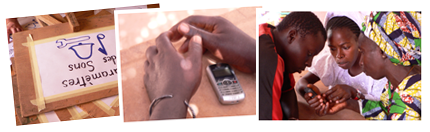

Monday, May 3, 2010

The Guediawaye CMC : Exemplary Social Entrepreneurs and Activists


Last week, Guillaume, Malick and I had the opportunity to sit in on a Community Management Committee (« CMC » in Tostan-ese) meeting in Guediawaye, on the outskirts of Dakar. Tostan is currently running its 30 month-long human rights-based non-formal education program in Guediawaye. While participants won’t be starting the Jokko module for literacy and social empowerment until October 2010, we have a lot to learn from this village in the meanwhile!
Some context : During Tostan's education program, we help found a community-based organization to support local development projects long after we've left the village. The CMCs are composed of 17 democratically-elected community members – including a minimum of 9 women – who engage in income-generating activities in order to raise funds to support advocacy efforts and development initiatives.
Barely 2 years old, the Guediawaye CMC serves as an exemplar and is close to obtaining GIE (Groupement d'Intérêt Economique / Economic Interest Group) status, which is the most fundamental economic unit recognized by the Senegalese government. With the funds generated from fabric dying, millet grinding, table gardening and soap-making the Guediawaye CMC is able to support awareness-raising for the prevention of HIV /AIDS and malaria and to lead neighborhood clean-up activities.
The discussion in the CMC meeting was lively and inclusive (I only wish that my understanding of Wolof had been a bit better!).


Roof-top table gardens.


Ground millet, ready to be sold.


Dame Guéye leads an interactive exercise.


Malick and Guillaume discuss serious stuff.


Guediawaye CMC members talk strategy.


Lindsay Powell


Saturday, December 26, 2009

RapidSMS Seminar, Vélingara Dpt.

The objective of this field visit was to train 20 villages on the use of Tostan/UNICEF's SMS social networking plateform. So - as usual - we started by training our community trainers. And quite logically, the first question we asked them was: "C'est quoi Rapid SMS?"

News travels fast in Senegal. Each attendee knew already something about it and was eager to respond: "It's when you send multiple messages at once." "A cheaper method of communication."

Well, first non-decision of the day, we don't have to find a name for this service anymore: apparently everyone already calls it "RapidSMS"... And honestly, who cares about this kind of approximation when you have been in situ for 15 minutes and ownership is already showing promises?
While those present all understood the general concept of RapidSMS and its advantages, we went ahead and walked the group through a review of the workings of the system. With the exception of a few minor misunderstandings the group demonstrated a sound understanding of the system that they all hope will - hopefully - revolutionize communication in their communities. Recognizing the benefits and risks inherent in the RapidSMS system, one supervisor reminded the group, for example, of the financial responsibility taken on by Tostan and UNICEF. The group also participated in an exercise used to identify different types of messages that might be sent with RapidSMS and discuss how various community actors might react to them. The supervisor training ended with the establishment of an action plan and schedule for the village trainings, to take place through December 25th.


Keep on keeping on
The second phase of the seminar was opened with renewed energy. Both Soninke and Pulaar facilitators came together to hear an explanation of the system and to establish their objectives and expectations for the seminar. After the general meeting, they split into their respective language groups to work on the sessions, finally complete thanks to long hours of translation by assistant coordinator Finté Boiro (Pulaar) and facilitator Bathily Diabé (Soninke). Following some tinkering by tech expert Rowena, who both fixed both the printer and solved the ever-persistent Pulaar character difficulties by teaching us how to install the Pulaar fonts, we even managed to print copies with the correct words! Victory!
The supervisors gave the facilitators 15 minutes to look over each session before introducing them, as the facilitators will do in their respective villages in the coming weeks.
The days wouldn't have been complete without some lively expression of the participants' excitement. A number of songs set the whole group into motion, as they took turns jumping into the circle to celebrate the event through dance. The sole Anglophone facilitator, Idrissa, originally from the Gambia, and Boubacar Baldé presented an amusing skit on the advantages of RapidSMS.
"It's very good! It's very nice!" "C'est très bien, c'est très bien!"
In closing, Alimatou Diao, consultant from Casamance for the Jokko Initiative, passionately expressed her commitment to the project. "I think the project will be a success!" she declared, followed by the applause and cheers of her colleagues, eager to see her words proven right. She admitted that her involvement in the project had sometimes kept her from her usual responsibilities to her family. "We've made sacrifices, and we'll keep making sacrifices," she pledged.
Kandia
The first village we visited for the "community training" was a village not far from Velingara, called Kandia. We were welcomed with music and dancing and presented with gifts of cotton and rice in colorfully decorated calabashes. The Tostan supervisors prepared the room for the training, rolling out poster-sized papers with explanations of RapidSMS as well as blank sheets for participants to brainstorm about the uses and advantages of the system. Supervisors Abdoulaye Kande and Thierno Diallo taught those present about the system, answering questions posed. The day was used to prepare the participants for learning how to manipulate the system and practicing sending messages, activities which would take place the following day.
The second day was the day of triumph: frowning faces turned to smiling ones as the participants successfully managed to enter their "community" and subsequently send messages to the server. The room was filled with sounds of practice messages arriving in inboxes, each beep and ring coming to the surprise and delight of the cell phone-toting villagers. Not only did they seem to understand the benefits the system could bring to their community, they were visibly excited about the project.
Doubirou
The villagers in Doubirou were no less enthusiastic about the arrival of the Tostan team. The villagehad killed two goats in our honor, a gift we all enjoyed during our tasty and plentiful afternoon meal. The training took longer than expected, but the extra hours paid off. Each group was very proud to send their own message to the server and receive those of the other groups.
"We're happy to learn about RapidSMS," said the president of the Mutuelle de la Santé of Kolda. "It helps us a lot. The message can be sent to everyone.
When someone dies, I can't call everyone at one time; with RapidSMS I can. But with it comes responsibility. Inchallah, people will take the project in their own hands and be responsible in their use of the tool."
For Rowena, Malick, and me, this was the final village visit. We had come to the end of a busy but fun-filled two weeks in Velingara. Having grown more or less accustomed to our daily routine there, I think each of us was at least a little sad to say goodbye. For me, this also marked the end of my six months of work for Tostan. I felt grateful to have spent this time in Velingara. What better way to end than by seeing the project put into action?! The coordinators, supervisors, and facilitators truly inspired me with the hard work and energy they put forth to maintain the momentum of the Jokko Initiative. Congratulations Tostan and UNICEF! Keep up the good work!

Amy Van Dyke


Monday, November 30, 2009

Baseline line survey, Velingara (South East Senegal)


Credits: Leigh Jaschke

Friday, July 31, 2009

Keur Samba Laube, field visit

Guillaume goes over some notes with Awa (in black) and her friends Khoudjia and Binta.

The SMS team, led by its newly named local leader, Awa, meet with village members while taking a walking tour of KSL and explaining the SMS Forum program.

Tostan class members met to better understand the SMS Forum program and the potential for its use in promoting their community activities.

Another house visit with Awa.

Back in KSL

It was great being back in Keur Samba Laube, our inaugural test village. The little urban community on the edge of Mbour welcomed us back for a two day follow-up to our initial visit just over a month ago. It was great getting to reconnect, work, and hang out again with the villagers and our hosts.

Having demonstrated and set up the initial group for KSL during our first visit, we wanted to check back in with them, see how it was being used, clarify any confusions in the system, and see what advice they had for improvements. From Dakar we were able to identify two main problems we were hoping to address: a low volume of messages and slow growth of the network’s size.

Discussions with the villagers gave valuable insight. We quickly confirmed what we had been weary of following our experiences in Ouonk and Badioure, that we had been too restrictive in our initial implementation effort. Instead of limiting system use to large-sized community development activities, we decided to broaden the scope of accepted and encouraged messages to include social events like weddings and baptisms as well as any community-wide discussion that villagers felt was appropriate. In essence we want the system to be used not just as an event notification tool, but as a veritable community forum, free to be used as the villagers deem appropriate.

We are additionally hoping that this increased message volume will help address the problem of slow network growth. More volume will give villagers more interest in joining the network and in recruiting their friends. It will also get them more comfortable with the technology and give them more opportunities to practice their literacy skills.

Youth in particular continued to face the problem of lack of credit and also made clear that they had not been comfortable contributing to a full community discussion. The former remains a problem we would like to resolve with the phone company. The latter we addressed by creating a unique group for the KSL youth or “ksl jeunes”. Hopefully, this will serve as a safe space for KSL youth and they will feel more motivated to use and grow the system.

We also identified and trained two local community leaders, one for the youth and the other for the adult group, to be in charge of helping people join and serving as the first line of problem solving in the village. The local Imam was placed in charge of the adult group while Awa Diop, a 17-year-old college student was handed the reigns of the youth group. As we set up the youth group, Awa took us on a tour of KSL. We were all impressed as she explained to each group of people we encountered how the system works and its benefits in convincing them to join.


Finally, two Tostan facilitators in Mbour were extremely excited by the forum system. While they do not serve in insular “villages” like most Tostan classes, they were excited to use the system as a community discussion tool for their women’s groups. It will be interesting observing how their systems progress with almost nonexistent help in direct implementation from Tostan Dakar staff… stay tuned…

It was clear when we left that the people of KSL and Mbour understood the SMS system much more thoroughly than after our initial visit and that they were more motivated to use it. We’ll be eagerly following their progress.

Pictures: Awa Diop (bottom, in red hat) and the Imam, Ousseinou (top), our two local replicators in KSL

- SH

Monday, July 6, 2009

Ouonck

The only source of power in the village: the Orange phone tower. A guy is there full time to look after the phones.

Unoken = « enter » in Diola. The hut represents the SMS community. The stick figures represent the participants… Together they represent our attempt to reduce two months of work into a children’s picture.

The first attempt to use the system by Ouonck’s women’s association.

Guillaume’s telephone broke the system! Luckily, Jeff saves the day and repares it without too much complaining.

A quick review of the necessary commands to open an SMS message.


Yoro and Alimatou, our wonderful local Social Mobilization Agents, help a participant.

Friday, July 3, 2009

Keur Samba Laubé

Quick video camera training of one youth by Guillaume. The videos will soon be posted, incha’allah!

Sountou Ndiaye (a Tostan supervisor) and Mamoudou Ba (community trainer or “facilitator” in Tostanese), at a meeting where participants gathered to try to come up with the best methods for the system’s introduction into an urban environment.

Keur Samba Laubé youth during the training.

Terra conducts a participant interview (here, with the Imam of KSL), in order to better understand the behavior of our target group when it comes to cell phone use.

Same, here with Annette and a teacher from the community.

Sylvan facilitates a discussion with more advanced users on system usage.

It’s a learning experience for all… Even for the programmers, who learn that the system doesn’t like accents and other irregular characters. That’s a problem when you’re working with Wolof, Pulaar and Diolaa!

Ibrahima Ndiaye, host of the local Tostan radio show, which began in Mbour and aims to combine two approaches to social mobilization.
 
Blog adapted by Salim Drame