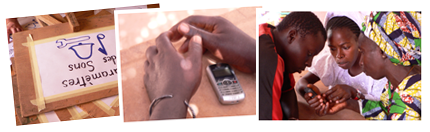
The objective of this field visit was to train 20 villages on the use of Tostan/UNICEF's SMS social networking plateform. So - as usual - we started by training our community trainers. And quite logically, the first question we asked them was: "C'est quoi Rapid SMS?"
News travels fast in Senegal. Each attendee knew already something about it and was eager to respond: "It's when you send multiple messages at once." "A cheaper method of communication."
Well, first non-decision of the day, we don't have to find a name for this service anymore: apparently everyone already calls it "RapidSMS"... And honestly, who cares about this kind of approximation when you have been in situ for 15 minutes and ownership is already showing promises?
While those present all understood the general concept of RapidSMS and its advantages, we went ahead and walked the group through a review of the workings of the system. With the exception of a few minor misunderstandings the group demonstrated a sound understanding of the system that they all hope will - hopefully - revolutionize communication in their communities. Recognizing the benefits and risks inherent in the RapidSMS system, one supervisor reminded the group, for example, of the financial responsibility taken on by Tostan and UNICEF. The group also participated in an exercise used to identify different types of messages that might be sent with RapidSMS and discuss how various community actors might react to them. The supervisor training ended with the establishment of an action plan and schedule for the village trainings, to take place through December 25th.
Keep on keeping on
The second phase of the seminar was opened with renewed energy. Both Soninke and Pulaar facilitators came together to hear an explanation of the system and to establish their objectives and expectations for the seminar. After the general meeting, they split into their respective language groups to work on the sessions, finally complete thanks to long hours of translation by assistant coordinator Finté Boiro (Pulaar) and facilitator Bathily Diabé (Soninke). Following some tinkering by tech expert Rowena, who both fixed both the printer and solved the ever-persistent Pulaar character difficulties by teaching us how to install the Pulaar fonts, we even managed to print copies with the correct words! Victory!
 The supervisors gave the facilitators 15 minutes to look over each session before introducing them, as the facilitators will do in their respective villages in the coming weeks.
The days wouldn't have been complete without some lively expression of the participants' excitement. A number of songs set the whole group into motion, as they took turns jumping into the circle to celebrate the event through dance. The sole Anglophone facilitator, Idrissa, originally from the Gambia, and Boubacar Baldé presented an amusing skit on the advantages of RapidSMS.
"It's very good! It's very nice!" "C'est très bien, c'est très bien!"
In closing, Alimatou Diao, consultant from Casamance for the Jokko Initiative, passionately expressed her commitment to the project. "I think the project will be a success!" she declared, followed by the applause and cheers of her colleagues, eager to see her words proven right. She admitted that her involvement in the project had sometimes kept her from her usual responsibilities to her family. "We've made sacrifices, and we'll keep making sacrifices," she pledged.
Kandia
The first village we visited for the "community training" was a village not far from Velingara, called Kandia. We were welcomed with music and dancing and presented with gifts of cotton and rice in colorfully decorated calabashes. The Tostan supervisors prepared the room for the training, rolling out poster-sized papers with explanations of RapidSMS as well as blank sheets for participants to brainstorm about the uses and advantages of the system. Supervisors Abdoulaye Kande and Thierno Diallo taught those present about the system, answering questions posed. The day was used to prepare the participants for learning how to manipulate the system and practicing sending messages, activities which would take place the following day.
The second day was the day of triumph: frowning faces turned to smiling ones as the participants successfully managed to enter their "community" and subsequently send messages to the server. The room was filled with sounds of practice messages arriving in inboxes, each beep and ring coming to the surprise and delight of the cell phone-toting villagers. Not only did they seem to understand the benefits the system could bring to their community, they were visibly excited about the project.
Doubirou
The villagers in Doubirou were no less enthusiastic about the arrival of the Tostan team. The villagehad killed two goats in our honor, a gift we all enjoyed during our tasty and plentiful afternoon meal. The training took longer than expected, but the extra hours paid off. Each group was very proud to send their own message to the server and receive those of the other groups.
"We're happy to learn about RapidSMS," said the president of the Mutuelle de la Santé of Kolda. "It helps us a lot. The message can be sent to everyone.
When someone dies, I can't call everyone at one time; with RapidSMS I can. But with it comes responsibility. Inchallah, people will take the project in their own hands and be responsible in their use of the tool."
For Rowena, Malick, and me, this was the final village visit. We had come to the end of a busy but fun-filled two weeks in Velingara. Having grown more or less accustomed to our daily routine there, I think each of us was at least a little sad to say goodbye. For me, this also marked the end of my six months of work for Tostan. I felt grateful to have spent this time in Velingara. What better way to end than by seeing the project put into action?! The coordinators, supervisors, and facilitators truly inspired me with the hard work and energy they put forth to maintain the momentum of the Jokko Initiative. Congratulations Tostan and UNICEF! Keep up the good work!