|
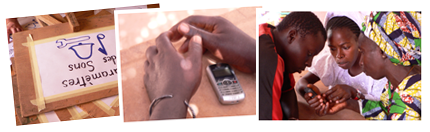
| The solar-powered charging station, a critical part of the Jokko Telecenter |
During the course of the CEP, Tostan establishes community-based organizations – called Community Management Committees (CMCs) – composed of 17 democratically-elected community members whose role is to manage and coordinate CEP activities and ensure collaboration between CEP participants and other community members. After having received project management training, the CMCs are provided with sums ranging from $400 to $1,000 and support from Tostan to implement income-generating activities in order to generate funds for local development and initiatives.
Once the CEP has ended, CMC members continue to serve as social entrepreneurs and activists in their communities. With the necessary development tools and leadership skills in hand, CMCs develop and implement specific action plans through subcommittees focused on topics of importance to the community: from environmental issues, to community health topics, from education and social mobilization, to income generating activities and child protection. Over time, many CMCs register as official community-based organizations in their respective countries, which reinforces community capacity while ensuring that funds, projects, and campaigns are managed in a transparent and professional manner.
In 2006, Tostan created the Empowered Communities Network (ECN) to support the more than 1,500 existent CMCs in their grass-roots development processes by facilitating linkages with other development partners, microfinance institutions, businesses, and government authorities. The ECN is the tool developed by Tostan that guarantees the sustainability of the CEP’s local impacts.
In October 2010, Tostan will be expanding activities to additional villages and identifying new mobile technology-based income-generating and social mobilization activities to serve the needs of rural communities. In June 2010, Tostan will support the implementation of community tele-centers in the Vélingara department in southern Senegal.
With the implementation of community tele-centers, the Jokko Initiative seeks to address key challenges faced by rural communities in accessing mobile technology - as identified in the continuous monitoring of the pilot phase – at the community-level, while providing the means for people to improve their lives and those of their children in a sustainable manner.
85% of rural Senegal is not covered by the national electrical grid. All the villages targeted for this project are off-grid. Observations in the field and preliminary feedback from CEGA show that the lack of electricity in these villages makes charging mobile phones (and by extension, all electronic devices) extremely problematic, requiring people to (1) Improvise with local power sources that prove hazardous to the village’s health (fuel lamps, etc.) and damaging to phone batteries (use of lead-acid car batteries to charge multiple electronic devices at once) or (2) Travel long distances to urban centers in order to have their mobile phones charged by small entrepreneurs. The latter often entails heavy expenditures on transport; a considerable loss of income due to time spent traveling; and increased risk of theft of and/or damage to phones (i.e. the replacement of good phone batteries with those of inferior quality when given to be charged in urban centers).
Also identified by community members and Tostan’s field workers as prohibiting the use of mobile phones is the unavailability - or otherwise high cost of - phone credit. People in rural Senegal often must travel to urban centers in order to purchase credit. When credit is available in rural villages, denominations are often more expensive by as much as 25% (i.e. credit sold at 1000 CFA in an urban center is sold for 1250 CFA in a village). As a result, many rural people cannot afford to use the mobile phones that they own or share with others.
A vast body of scholarly research reveals the disproportionate access of women and girls in the developing world to mobile technology (reference: Women and Mobile, GSMA and Cherie Blair report). Tostan’s experience and CEGA’s evaluation of the pilot phase confirms these findings.
In the baseline study of the pilot phase, CEGA identified a strong disparity between men and women relative to the use of mobile phones. The men interviewed were found to have both greater access to and better competency at using mobile phones than the women interviewed.
(1) Compared to 31% of men, only 12% of women had access to a mobile phone.
(2) Compared to 33% of men, 45% of women had never used a mobile phone.
(3) Men knew how to use the mobile phone’s calculator function 3 times better than women.
Solar energy household solutions, such as solar lanterns and solar home systems, are highly attractive to off-grid households. Households can considerably reduce their energy costs (kerosene, batteries) in the medium to long run, while access to electricity improves their living standard. People can become more productive, children can study after sunset. Moreover, these solutions do not require expensive and maintenance-sensitive electricity grids.
Rural Energy Foundation (REF) is a Dutch NGO which facilitates access to renewable energy to hundreds of thousands of rural people in sub-Saharan Africa. It does so by establishing effective and efficient supply chains (through the establishment and training of entrepreneurs and technicians in solar energy solutions), by stimulating demand (through large awareness campaigns), and by facilitating access to loans to entrepreneurs and end users. The approach works: during the past 3 years REF has facilitated access to electricity to more than 332,000 people at a cost of less than EUR 4 per connected person.
REF identifies, trains, and supports commercial retailers and distributors, so that these entrepreneurs start and expand a business in renewable energy household solutions. REF also provides solutions to their financial constraints, for example by guaranteeing the outstanding part of a loan with a guarantee fund. In addition, REF initiates large-scale marketing campaigns to stimulate demand for renewable energy products. Finally, we facilitate solutions where end users obtain credit to make the upfront investments.
REF is active in several countries in both East and West Africa, and has already developed a network of importers, distributors and retailers that covers a vast portion of Senegal. REF works with this network to develop the supply chain, ensuring the quality of the products and service, while working with MFIs to extend credit to micro-entrepreneurs.
In collaboration with REF, Tostan seeks to implement 2 income generating activities for CMCs in the department of Velingara, Senegal:
Small Business Applications (SBA)
The SBA consists of solar income-generating activities such as mobile phone and small electronic device charging, and solar-powered small businesses such as tailors and hair salons. When up and running, the system needed to run the SBA could be earned back in less than half a year.
There are several advantages to placing an SBA in the heart of the rural areas, such as lower expenditure of money on travel for charging purposes. Moreover, by involving the community leaders, there is a significantly reduced chance of theft or damage due to increased social control. Part of the revenue from the charging business can be reinvested in the community, making the customer the ultimate beneficiary.
Furthermore, other advantages include: the use of the portable solar system to power other micro-enterprises (tailor, salon, bush-cinema); the portability reduces risk of theft, and allows the entrepreneur running the business to even frequent weekly markets or other places where people from neighboring villages often gather, to create awareness and earn an income by e.g. charging phones.
Sales Agents
The sales agents program entails that local entrepreneurs start acting as representatives for retailers endorsed by REF, and help sell solar products and provide maintenance for solar installations in their villages. For large installations, the sales agent will refer the potential customer to the retailer’s shop, but smaller products (such as solar lanterns) could be sold on the spot. The sales agent is often paid a commission per system sold in that specific community.
The sales agent is therefore directly linked to a specific retailer (holder of the “Solaire Ici” quality label develpped by REF), and receives the needed training and material from the retailer (with guidance from REF). The sales agent’s responsibilities then include: convincing the potential customers, sensitizing the general public to increase awareness and help disseminate information regarding renewable energy solutions, and do promotional activities in collaboration with the retailer. From the part of the retailer, responsibilities include: delivery of promotional materials, providing the actual selling point for renewable energy solutions, and perform the installation and maintenance.
Microfranchising is a development tool that seeks to apply the proven marketing and operational concepts of traditional franchising to small businesses. The primary feature of a microfranchise is its ability to be streamlined and replicated in the most remote areas.
Seddo and Izi are two services developed by respectively Orange Sonatel and Tigo Sénégal (the two major telecommunication companies in Senegal). They allow small entrepreneurs and street vendors to use Orange’s and Tigo’s franchises to retail phone credit and SIM cards.There are two ways to retail phone credit in Senegal.
- Sell credit cards, ranging from 1000 FCFA (approx. 2 USD) to 10000 (approx. 20 USD)
- Sell small amount of phone credit (100 FCFA and more) via a phone-to-phone transfer system.
Through their Community telecenter activities, CMCs will engage in micro franchise: retail of credit, via transfer and selling Seddo and Izi cards and provide calling and texting services. For each transaction, they will earn a small commission. Tostan will support them into contracting with Sedd and Orange, and will provide an adapted training on marketing methods and management of this new income generating tool.
A portion of the funds yielded by the income-generating activities of the community tele-center will be dedicated to providing SMS texting free-of-charge for women of girls. Under this initiative, SMS texts must be development-related and sent to a specific list of contacts, using the RapidSMS Forum (cf. annex). A paper phone book as well as mobile directories with listings for local development actors (including Tostan regional staff, RapidSMS, CMCs in the region, and SAV distributors) will be provided.
This social mobilization activity will facilitate increased access of women and girls to mobile phones, serving to help close the gendered mobile gap while enhancing opportunities for women and girls to practice their literacy skills and expand their communicative network.
Guillaume