Friday, September 11, 2009

Tostan's web UI, developped by RapidSMS team

This website allows Tostan and its partners to visualize and keep track of all text messages sent to the system by our test communities. As you can imagine, this is an extremely powerful tool for monitoring and evaluation of the program, that CEGA (the Center of Evaluation for Global Action, UC Berkeley) and Tostan's M&E dept. will use for future impact evaluation and mapping of social networks in Senegal.


Sunday, September 6, 2009

Tostan Featured in Half the Sky by Nicholas D. Kristof and Sheryl WuDunn


"'[Tostan has] done what UN conferences, endless resolutions, and government statements have failed to do,' Foege told us. 'When the history of African development is written, it will be clear that a turning point involved the empowerment of women. Tostan has demonstrated that empowerment is contagious, accomplished person by person and spreading village by village.'" (Half the Sky, p. 228)


Tostan's work is praised in a full chapter of Nicholas D. Kristof and Sheryl WuDunn's new book, Half the Sky: Turning Oppression into Opportunity for Women Worldwide. The book is both a hard-hitting description of the difficulties women face around the globe, and a call to action, with inspiring stories of how a little help goes a long way in transforming the lives of women and girls abroad.


I read Half the Sky in one sitting, staying up until 3 a.m. to do so. It is brilliant and inspirational, and I want to shout about it from the rooftops and mountains. It vividly illustrates how women have turned despair into prosperity and bravely nurtured hope to cultivate a bright future.
— Greg Mortenson, author, Three Cups of Tea


Friday, July 31, 2009

Keur Samba Laube, field visit

Guillaume goes over some notes with Awa (in black) and her friends Khoudjia and Binta.

The SMS team, led by its newly named local leader, Awa, meet with village members while taking a walking tour of KSL and explaining the SMS Forum program.

Tostan class members met to better understand the SMS Forum program and the potential for its use in promoting their community activities.

Another house visit with Awa.

Back in KSL

It was great being back in Keur Samba Laube, our inaugural test village. The little urban community on the edge of Mbour welcomed us back for a two day follow-up to our initial visit just over a month ago. It was great getting to reconnect, work, and hang out again with the villagers and our hosts.

Having demonstrated and set up the initial group for KSL during our first visit, we wanted to check back in with them, see how it was being used, clarify any confusions in the system, and see what advice they had for improvements. From Dakar we were able to identify two main problems we were hoping to address: a low volume of messages and slow growth of the network’s size.

Discussions with the villagers gave valuable insight. We quickly confirmed what we had been weary of following our experiences in Ouonk and Badioure, that we had been too restrictive in our initial implementation effort. Instead of limiting system use to large-sized community development activities, we decided to broaden the scope of accepted and encouraged messages to include social events like weddings and baptisms as well as any community-wide discussion that villagers felt was appropriate. In essence we want the system to be used not just as an event notification tool, but as a veritable community forum, free to be used as the villagers deem appropriate.

We are additionally hoping that this increased message volume will help address the problem of slow network growth. More volume will give villagers more interest in joining the network and in recruiting their friends. It will also get them more comfortable with the technology and give them more opportunities to practice their literacy skills.

Youth in particular continued to face the problem of lack of credit and also made clear that they had not been comfortable contributing to a full community discussion. The former remains a problem we would like to resolve with the phone company. The latter we addressed by creating a unique group for the KSL youth or “ksl jeunes”. Hopefully, this will serve as a safe space for KSL youth and they will feel more motivated to use and grow the system.

We also identified and trained two local community leaders, one for the youth and the other for the adult group, to be in charge of helping people join and serving as the first line of problem solving in the village. The local Imam was placed in charge of the adult group while Awa Diop, a 17-year-old college student was handed the reigns of the youth group. As we set up the youth group, Awa took us on a tour of KSL. We were all impressed as she explained to each group of people we encountered how the system works and its benefits in convincing them to join.


Finally, two Tostan facilitators in Mbour were extremely excited by the forum system. While they do not serve in insular “villages” like most Tostan classes, they were excited to use the system as a community discussion tool for their women’s groups. It will be interesting observing how their systems progress with almost nonexistent help in direct implementation from Tostan Dakar staff… stay tuned…

It was clear when we left that the people of KSL and Mbour understood the SMS system much more thoroughly than after our initial visit and that they were more motivated to use it. We’ll be eagerly following their progress.

Pictures: Awa Diop (bottom, in red hat) and the Imam, Ousseinou (top), our two local replicators in KSL

- SH

Tuesday, July 21, 2009

How to leave the SMS Forum

System users are not prisoners! For those who leave a given community or no longer wish to remain in the virtual forum, leaving the system is simple. The message again starts with "123" followed by the word "leave" in any of the system's languages (Wolof, Pulaar, Diola, English, or French). Including the community name will tell the system which community you would like to leave (if you belong to more than one), but is ultimately unnecessary.

A simple message of "123 leave" will remove the user from all communities, though they will be free to reenter later should they so choose.

How to send a message to the SMS Forum

Once someone has entered into a community they are ready to send and receive messages with the other users. Now, Fatou only has to write a message and send it to the "magic number" for it to then be distributed to all of the other registered users (represented in green). She pays only the cost of the initial message, while the message replication remains free. Those who have not registered in the system will not receive the message. This serves as a powerful community-wide forum that can be used to notify community members of important events or to engage a broader audience in community dialogue and discussion.

How to join the SMS Forum


Before users are able to send messages to the group and receive messages from other users, they must join an identified "community". This is done by sending a simple SMS text message that follows a certain formula to the "magic number". The message must start with "123" so that the system identifies the message as a system command (ie the sender wants to join or leave the system, or register their name). The "123" is followed by a space and the then word "join" and finally, the name of the community the user would like to join. They are now ready to send and receive messages within the community they identfied. Above, Fatou has just joined the group "tostan".

"Join" can be written in a range of languages including Wolof, Pulaar, Diola, English, and French. Following this initial command, the system will remember this initial language preference and send system messages in that local language (note- content messages sent by other users will remain as they are written, but system communications such as message confirmation/failure, name registration etc. will all be in local language).

Monday, July 6, 2009

SMS poetry

This is a message sent from the Badiouré network (anonymous author). And it's awesome.
"Puvoir tuché tt l monde come si l monde été une ronde: simpl ingégn 1guin d temp TOSTAN ns t some reconéçen"

Translation:
"Being able to reach the world as if the world was just a round dance: easy, well-thought, a gain of time. Tostan, we are grateful"

And it actually rhymes in French !


-GD

Ouonck

The only source of power in the village: the Orange phone tower. A guy is there full time to look after the phones.

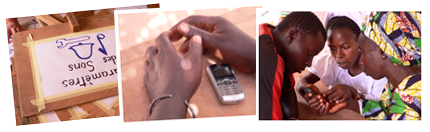
Unoken = « enter » in Diola. The hut represents the SMS community. The stick figures represent the participants… Together they represent our attempt to reduce two months of work into a children’s picture.

The first attempt to use the system by Ouonck’s women’s association.

Guillaume’s telephone broke the system! Luckily, Jeff saves the day and repares it without too much complaining.

A quick review of the necessary commands to open an SMS message.


Yoro and Alimatou, our wonderful local Social Mobilization Agents, help a participant.

Sunday, July 5, 2009

SMS social network

Here’s a glimpse of the community SMS service we’re developing…The basic idea for the project is to reinforce the “organized diffusion” social mobilization approach, used to spread development initiatives led by Senegalese communities. The project aims to increase awareness about activities and, consequently, increase their impact.

So how’s it work?
Let’s leave the technical aspects aside for the moment and focus on the overall idea.
Tostan is looking to bring its most enthusiastic community development actors together in a network based entirely on SMS messaging. In other words, through one quick and simple action (sending an SMS to our server), a user subscribes to a service that will simultaneously send messages to multiple users located in his/her village and the immediate surrounding areas.
Everyone can be part of the same SMS community: the community nurse and his/her counterparts in neighboring villages, teachers and student groups, women’s groups, Tostan classes, the village chief, the imam, etc. When one person sends a message to the regular, non-premium number, everyone in the SMS community receives it.
For example, the Community Management Committees formed by Tostan frequently organize awareness-raising events surrounding various themes such as malaria, human rights, income-generating activities or the importance of a healthy environment. The only two real ways to spread the word about such occasions are by word of mouth or going door to door. With the community SMS system, the CMCs can inform the most influential members of the community cheaply and efficiently. These people can then pass on the information within their own circles (during the prayer for the imam, during class for teachers, at weekly youth or women’s meetings, etc.).

The SMS community is open to all and only costs the price of a message. When we went to lead trainings during the program’s discovery process, we were surprised at how easy the service was to use in these communities with such an urgent need for communication. The observed levels of motivation and adoption seemed to be extremely high following the three initial trainings in Keur Samba Lauvé, Ouonck and Badiouré.
With simplicity remaining our main goal, we would like to learn more about the communication needs of the villages in order to develop (incha’allah) other SMS services that are ever more practical and user-friendly, and thus, in theory, accessible to all.

-GD

Friday, July 3, 2009

Keur Samba Laubé

Quick video camera training of one youth by Guillaume. The videos will soon be posted, incha’allah!

Sountou Ndiaye (a Tostan supervisor) and Mamoudou Ba (community trainer or “facilitator” in Tostanese), at a meeting where participants gathered to try to come up with the best methods for the system’s introduction into an urban environment.

Keur Samba Laubé youth during the training.

Terra conducts a participant interview (here, with the Imam of KSL), in order to better understand the behavior of our target group when it comes to cell phone use.

Same, here with Annette and a teacher from the community.

Sylvan facilitates a discussion with more advanced users on system usage.

It’s a learning experience for all… Even for the programmers, who learn that the system doesn’t like accents and other irregular characters. That’s a problem when you’re working with Wolof, Pulaar and Diolaa!

Ibrahima Ndiaye, host of the local Tostan radio show, which began in Mbour and aims to combine two approaches to social mobilization.

Thursday, June 25, 2009

Back in Ziguinchor

Kassumay,

Back in Ziguinchor (in the south of Senegal) as of this morning, after an intense workweek with our hosts in the village of Ouonck, unarguably a “golden child” of Tostan. Judge for yourself:

Ouonck is a previous Tostan center (a recipient of the program thanks to funding from UNICEF, 2005­­­–2007), with a Community Management Committee that remains extremely active to this day (it has actually just procured funding, almost entirely on its own, for a classroom to be shared with teachers from the community school). It has no electricity or running water but boasts a small cybercafé and an algae farm (containing Spirulina algae, which is cultivated in tubs then distributed as a food supplement) and a network of associations—including youths, women and farmers—as dense as a good ceebu jen.

In other words, it’s a dream village for our team.

We conducted four days of training and data collection to help us better understand the behavior of the rural populations of this part of Senegal when it comes to the use of cell phones.

We recognized from the outset an urgent need for communication within the community and the lack of efficiency of the “traditional” social mobilization mechanisms (spreading information by word of mouth and door to door).

Our main concern is the absence of a system for organization between different local development actors (community health workers, literacy trainers, women’s and youth associations, traditional leaders, teachers, etc.). The members of the community are available, active and motivated, but they lack a practical, low-cost system that would allow them to organize and plan events efficiently. As a result, the task of mobilizing the residents of Ouonck for raising awareness on malaria, community clean-ups or even intervillage football games can be a slow and at times discouraging one.

Our plan—rather than seeking to brusquely replace the current mobilization tools (which have the positive characteristic of encouraging human contact) with a foreign system having no real legitimacy in the community—is to introduce a practical, low-cost system that encourages group decision-making among local development actors.

This system, or at least its first version, has been jointly developed by Tostan and ___. It makes it possible to link up and communicate with a community network by simply sending a text message. That means, if a nurse, literacy leader, representative of a women’s association and village imam are looking to inform the community about something important, they can send a message to a number that then forwards the message to all phone numbers belonging to the network—much more efficient than walking from door to door. The system’s commands and options are all available in local languages, and we hope that our emphasis on accessibility will ensure the system’s adoption by the largest number of users possible.

Diffusion of the system should occur naturally: Tostan is training some fifteen “catalysts,” figures who are active in community development, who then contribute to the growth of the network by informally training other members of the community. This service also reflects Tostan’s philosophy on community-led development, with villagers deciding for themselves the size and the focus of their network and also managing possible abuse of the system by defining its limits.

- GD

Monday, June 15, 2009

Introduction

Salaam Aleïkoum,

The post below, courtesy of Cody Donahue, who recently found it on a Senegalese forum, had a huge impact on me. Its anonymous author confirmed the importance of our project in her own way. African youths, both rural and urban, are confronted by an urgent need for communication. They are progressively adopting information technology. The next step is to make the adoption of these new tools more universal, so that they can support the attitudinal changes necessary for the abandonment of harmful traditional practices such as FGC or forced/child marriage.

“[…] my mother is Pulaar and my father is Wolof and my father never liked that. They did it to me when my father was on mission and my mother, little sister, and I were on vacation at my grandmother’s, who believes in the tradition. Her cousin performed the operation on me and my sister and the thing I’ll never forget is the memory of how sick I was at first and how my mother was afraid that my father would find out. He still doesn’t know to this day. My little sister said she was going to tell, but I was afraid there would be a divorce. I got married but it still troubles me and it’s not pretty. I’ve never forgiven them and I will never do this to my children because it’s dangerous.”

-GD

Thursday, August 7, 2008


September 30, 2010

From Illiteracy to mCommunity, Jokko Initiative Empowers Women with mLearning

By Wayan Vota (Inveneo, ICT Works, etc.)

Since 1991, Tostan has brought its holistic, 30-month Community Empowerment Program based on human rights to thousands of communities in West Africa. As part of this program, they teach basic literacy and numeracy to community participants, particularly women and girls, but not without problems.


September 13, 2010


C8 L8ter? Using Mobile Phones as Literacy Tools in Niger


I recently received a text message from my friend Karim in Niger, asking “Keski ce passe?” (What’s happening?).  Those of you who know French might notice his text is an abbreviation of the much longer expression for “Qu’est-ce qui se passe”, which is formal and proper but a bit long when you only have 140 characters. 

[Read more]


June 24, 2010


Tostan Talks Jokko at Tech Salon


On June 10th, Gannon Gillespie (Tostan Director of US Operations) represented the Jokko Initiative at The Cloudy SMS4D-2 Technology Salon, focused on cloud-based solutions.  The Technology Salon -  sponsored by the UN Foundation and the Vodafone Foundation -  was started in 2008 by Wayan Vota as a forum where technology and development professionals could share their opinions on emerging trends in ICT and international development in an intimate and informal discussion.  


Gannon shared Tostan's experience with the Jokko Initiative's RapidSMS-based Community Forum, which allows a community member to disseminate information to a virtual network of her peers by sending a single text message to the Tostan server. 

[Read more]


 May 26, 2010
Published conconversationsforabetterworld.com (25.05.2010)
Also featured on humanitariannews.org (26.05.2010)

Tostan and the Jokko Initiative: Mobile Technology Amplifying Social Change

With mobile phone networks rapidly expanding to reach the vast majority of Senegalese citizens, and with mobile phones already commonplace in even the most remote villages, mobile technology quickly appeared to us as to be a promising new pedagogical tool for literacy.


March 25, 2010
Published on clintonglobalinitiative.org (03.2010)

The Jokko Initiative Named "Exemplary" by the Clinton Global Initiative

The Clinton Global Initiative is a non-partisan catalyst for action, bringing together global leaders including heads of state, non-profit organizations, charities, and business leaders to discuss challenges facing the world today and to devise and implement innovative solutions to some of the world's most pressing challenges.

Commitments to Action are a unique feature of CGI membership and serve to translate practical goals into meaningful and measurable results. Tostan's Commitment to CGI, « Extending a Model for Community Empowerment across Africa », describes the Jokko initiative and has been recognized as "exemplary" under the CGI 2010 Action Area « Enhancing Access to Modern Technology » .


March 18, 2010
Published on GSMWorld.com (03.2010)


The Jokko Initiative: Building Literacy, Building Leaders

The Jokko Initiative is featured in Women & Mobile: A Global Opportunity, a comprehensive global research report on the gender gap in the mobile phone industry in develop
ing and transition countries produced by the GSMA Development Fund in partnership with the Cherie Blair Foundation for Women and launched at the Mobile World Congress held last month in Barcelona.

The report highlights the Jokko Initiative's success in reinforcing women's literacy skills and building their confidence as agents of social change.


March 7, 2010
Published on TheDailyBeast.com (03.07.2010)

Connected Communities: Mobile Technology and Positive Social Change

The Jokko Initiative is featured in Tom Watson's article, "Technologies that Empower Women."


August 10, 2009
Published on ICTWorks (08.10.2009)

SMS Forum, Creating Mobile Phone Communities with RapidSMS

Everyone knows how SMS works - you can send an email to one other person. And there are SMS aggreators like Frontline SMS that allow you to send text messages to multiple people. But now we have RapidSMS, which promises to take SMS text messaging to a whole new level.


August 6, 2009
Published on MobileActive.org by Leigh Jaschke (08.06.09) 


Blog adapted by Salim Drame