


Credits: Leigh Jaschke
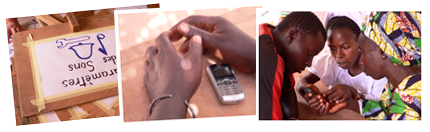


 From the 27th to 30th of September, Tostan implementation staff gathered in Thies for the Jokko Seminar. Over the course of the four days, the 70 participants from all over Senegal and Mauritania were introduced to the new module on the use of mobile phones for literacy and community development(see picture).
 ating their commitment to the project and Tostan’s mission, the enthusiastic attendees listened to presentations on the project and contributed their suggestions and ideas for the development of the Initiative. At the end of each day, participants met in their assigned groups to plan for the following day’s activities, including each group’s presentation of one of the module sessions.


 Guillaume goes over some notes with Awa (in black) and her friends Khoudjia and Binta.
 The SMS team, led by its newly named local leader, Awa, meet with village members while taking a walking tour of KSL and explaining the SMS Forum program.
 Tostan class members met to better understand the SMS Forum program and the potential for its use in promoting their community activities.
 Another house visit with Awa.
 It was great being back in Keur Samba Laube, our inaugural test village. The little urban community on the edge of Mbour welcomed us back for a two day follow-up to our initial visit just over a month ago. It was great getting to reconnect, work, and hang out again with the villagers and our hosts.
 was placed in charge of the adult group while Awa Diop, a 17-year-old college student was handed the reigns of the youth group. As we set up the youth group, Awa took us on a tour of KSL. We were all impressed as she explained to each group of people we encountered how the system works and its benefits in convincing them to join.
 System users are not prisoners! For those who leave a given community or no longer wish to remain in the virtual forum, leaving the system is simple. The message again starts with "123" followed by the word "leave" in any of the system's languages (Wolof, Pulaar, Diola, English, or French). Including the community name will tell the system which community you would like to leave (if you belong to more than one), but is ultimately unnecessary.
 Once someone has entered into a community they are ready to send and receive messages with the other users. Now, Fatou only has to write a message and send it to the "magic number" for it to then be distributed to all of the other registered users (represented in green). She pays only the cost of the initial message, while the message replication remains free. Those who have not registered in the system will not receive the message. This serves as a powerful community-wide forum that can be used to notify community members of important events or to engage a broader audience in community dialogue and discussion.
 The only source of power in the village: the Orange phone tower. A guy is there full time to look after the phones.
 Unoken = « enter » in Diola. The hut represents the SMS community. The stick figures represent the participants… Together they represent our attempt to reduce two months of work into a children’s picture.
 The first attempt to use the system by Ouonck’s women’s association.
 Guillaume’s telephone broke the system! Luckily, Jeff saves the day and repares it without too much complaining.
 A quick review of the necessary commands to open an SMS message.
 Here’s a glimpse of the community SMS service we’re developing…The basic idea for the project is to reinforce the “organized diffusion” social mobilization approach, used to spread development initiatives led by Senegalese communities. The project aims to increase awareness about activities and, consequently, increase their impact.
 Quick video camera training of one youth by Guillaume. The videos will soon be posted, incha’allah!
 Sountou Ndiaye (a Tostan supervisor) and Mamoudou Ba (community trainer or “facilitator” in Tostanese), at a meeting where participants gathered to try to come up with the best methods for the system’s introduction into an urban environment.
 Keur Samba Laubé youth during the training.
 Terra conducts a participant interview (here, with the Imam of KSL), in order to better understand the behavior of our target group when it comes to cell phone use.
 Same, here with Annette and a teacher from the community.
 Sylvan facilitates a discussion with more advanced users on system usage.
 It’s a learning experience for all… Even for the programmers, who learn that the system doesn’t like accents and other irregular characters. That’s a problem when you’re working with Wolof, Pulaar and Diolaa!
 Ibrahima Ndiaye, host of the local Tostan radio show, which began in Mbour and aims to combine two approaches to social mobilization.


